Book Jacket
By James Terault
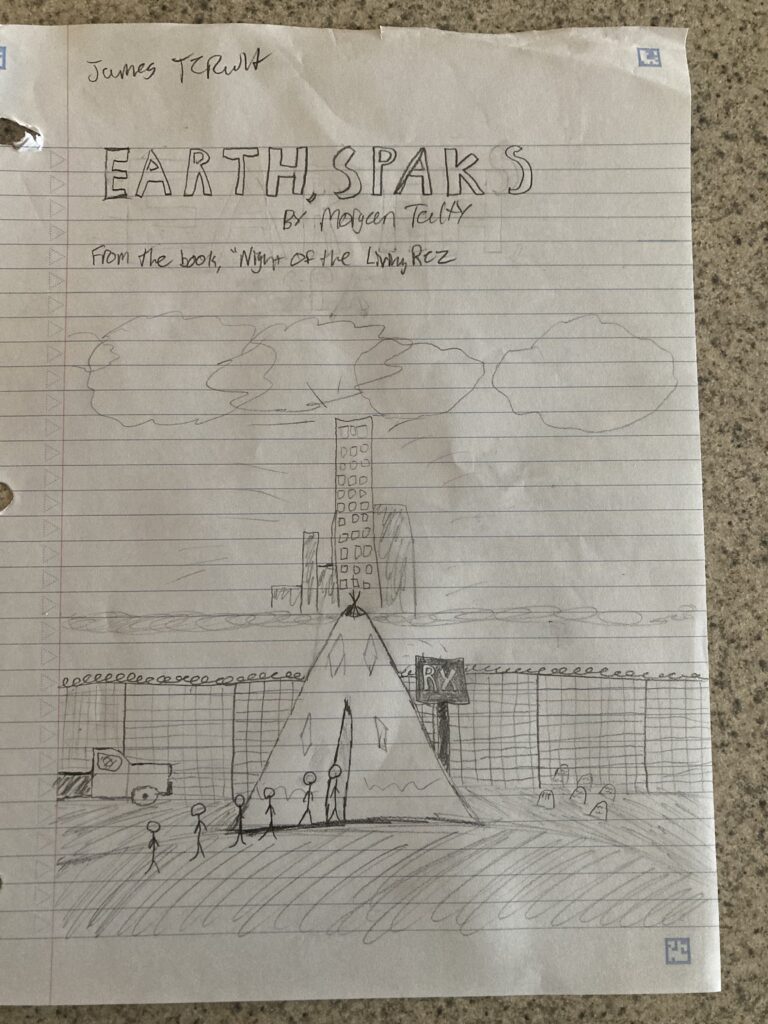
Morgan Talty’s “Earth, Speak”, from the book Night of the Living Dead is the culmination of a native man, Dee’s, journey through addiction, cultural isolation and the ever-bearing pressure of the outside world attempting to turn his heritage into a steady source of income. This chapter explores the deep rifts in the native American’s daily lives on the reservation between themselves and their past. As Dee presses on towards remission, other factors attempt to bring him back down to the muddy earth. Will he be pulled back into that life, or shall he finally allow his mind, body, and soul to sweat out all the evil he has kept inside?
“A brilliantly crafted masterpiece. The work Morgan Talty has done to bring the dire situation that is the native American’s life on the horrid reservations is nothing short of miraculous. To be able to so astutely show how our land was stolen and yet we continue to study and respect our culture is amazing. This is what the world needs to read and needs to hear. Now, it just needs to act on it.” Mihku Paul, Author of The Water Road.
“Nothing short of revolutionary! A true call-to action for the beholden natives of these Democratic states! A piece of work so American that it deserves to be put into a hall of American renaissance writers, to be put into the living, social consciousness of the American public to be able to wrestle with the struggle of their own history!” Thomas Paine, Author of Common Sense.
Artist Intent
Since this project was assigned, I knew that I wanted to do it on Night of the Living Rez, or the chapter we read, “Earth, Speak”, specifically because I was deeply engaged with the text and felt like I could connect and understand all of its ideas with relative ease; not because the ideas were simple, but because they were so well laid out. It was also a fun piece of work not only to read but to comprehend, and I enjoyed discussing and working on the text in and out of class the most out of everything else we have worked on. This is probably my preference for narrative stories in a more “book” form compared to the poetry or informative novels we have read for the rest of the semester. And ever since the beginning, I knew who my two “blurbers” would be, having read Mihku Paul’s poem before Talty’s work was a great way to connect two native American authors together, and since I knew we were going to talk about Thomas Paine and I had already read one of his pieces of work in a different class, I knew I was going to be able to write about him as well. Using both Mihku and Thomas, I planned to try to showcase two sides of American history that connect well with what Talty wrote about. For Mihku, it was the connection to the native American culture and their long and storied history with colonization and the effects it still has on them. It was also important to me to be able to make a point on the resilience of the native American peoples and their ability to still push for their own spiritual and physical freedom, even in the modern age. For Paine, I wanted to showcase how a past perspective on a more modern text might look while also using his specific language around his revolutionary fervor. I made this connection to showcase the merit that Morgan Talty’s work has to justify it being a larger part of the American narrative in respect to its long history of colonialism. I do not think that Thomas Paine would really understand some of the ideas that Talty brings up, such as cultural alienation, but I think he would at least understand the struggle for freedom of not just the physical body but of the soul as well, which is something Paine was concerned about when it came to the American Revolution as well. Now, it is important to note, my artistic ability is not anything that I care to write home about. However, I have tried my best with this knowledge to create something that could resemble a lot of the ideas that come from the chapter of Night of the Living Dead that we did actually read.
Now, it is important to note, my artistic ability is not anything that I care to write home about. However, I have tried my best with this knowledge to create something that could resemble a lot of the ideas that come from the chapter of Night of the Living Dead that we did actually read. For the drawing, I decided to thread in many of the points made throughout the chapter, with a large focus on the alienation that the main character, Dee, feels towards their own culture. To resemble this, I have attempted to draw a teepee to resemble how the outside world views the Native American’s living conditions, as well as a way to resemble the culture and history of the native’s themselves and the ways in which this history has been bent by the modern world and its culture. I then decided to add the sign that says “RX” as a way to tie into the story going into the deep end of the drug addiction problem that many Native American’s fall into in order to deal with the stress of what modern society puts upon them, from their inability to exist on their own native lands to the separation that society has imparted onto them. The line of people stretching out from the tent is another way to show the dependence on the drugs that the main character describes in the chapter. Something that a friend of mine, someone who has lived in Maine all his life told me something really fascinating about the natives that live between Maine and Canada, and that is the fact that they are not legally allowed to own liquor selling licenses. When thinking about this book, I thought about the connection to this story my friend told me, and it made me realize that the U.S. Government has decided that Native American’s are very likely to become addicted to alcohol, but that drugs are a good way to keep them docile. The fence around the teepee is to represent the walls that modern American society has put up around the Native American’s, and the fact that they are being caged into these small, purposefully faraway places that no one really wants to live, out of the eyes of the modern U.S. Citizen in an effort to keep these communities isolated and poor. Another connection to this fence was the graveyard being cut in half by the fence. For this, I wanted to show the disconnection between those living in the reservations and their ancestors, along with the ways in which the U.S. Government continuously attempts to tear apart the sacred land of the natives. This also shows the spiritual disconnect for the Native American’s alive today, with most of their history either being white-washed or painted as “long lost history”, playing on that Vanishing Indian trope. The city in the back symbolized the ever-encroaching modern world, hoping to take over what little land that we have given to the natives. It also shows the pressure put onto the Native Americans to assimilate into modern America. Lastly, the truck on the side is to resemble Fellis and the events that take place, specifically with Daryll and the fact that this shows the violence and depravity that the Native American’s are subjected to due to the actions of colonizers. I believe this book is a way of showcasing the grander effects of American Colonization on the Native Americans and the ways in which their lives have been shaped by the hundreds of years of repression and neglect by the U.S. Government.
